🚀 团队愿景 (Vision)

本研究组聚焦 AI4Science,利用深度学习与人工智能算法结合单细胞等测序技术数据,致力于对细胞的数字化建模和分析,揭示细胞的功能复杂性与异常机制。研究重点是从单个细胞中提取多组学多模态生物信息,构建细胞的计算模型。研究内容包括:批次整合、细胞(癌细胞)类型注释与识别、基因调控网络的建模和分析、细胞发育和分化的机制研究、药物敏感性预测、复杂疾病(癌症)的机制研究等,从而促进学术界或者产业界的认知与实践。
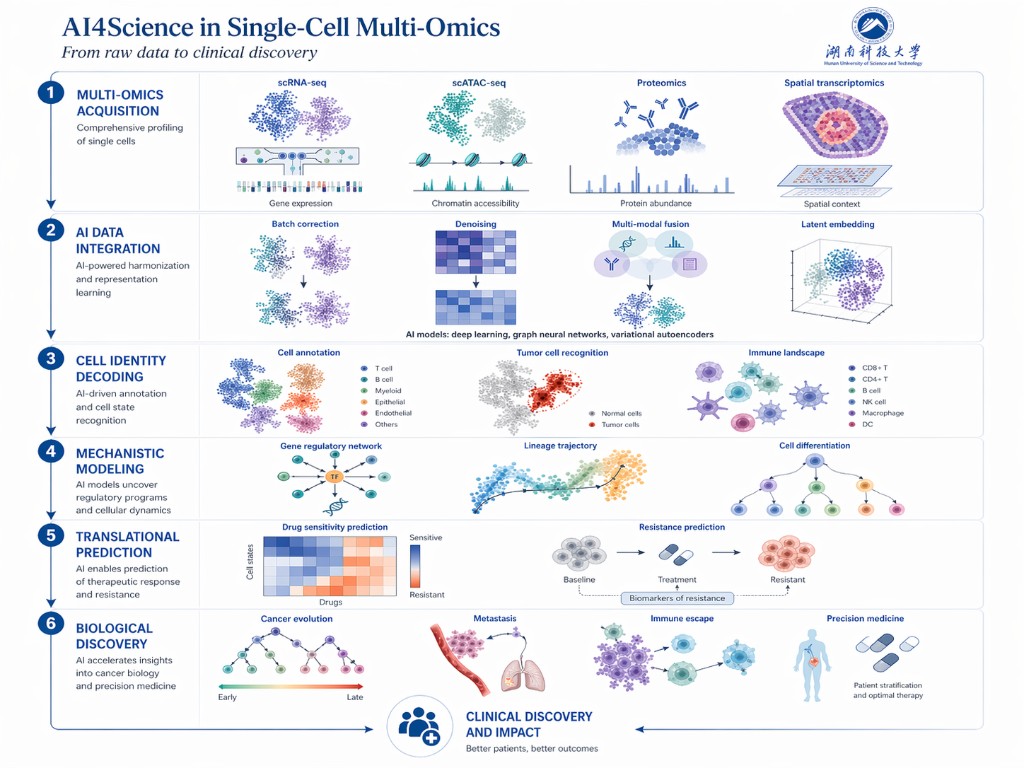
AI4Science in Single-Cell Multi-Omics: From raw data to clinical discovery

🤝 团队文化 (Culture)

平等、极致、反思、迭代

👥 团队成员 (Members)

PI:陈向 博士
研究生:22级余俊楠(已毕业),23级马永康(已毕业),24级刘小宇,24级杨子涵,25级郭文禄,25级谢芷翼,26级陈诗琦,26级唐振龙,26级杨浩宇
本科生:21级聂艺洋(保研河海大学),21级曾家伟(考研湖南科技大学),21级曾嘉诚(考研湖南科技大学),22级何文锋(保研中南大学)
欢迎 👏 未来的你加入本研究组,如有意请查看至本页尾部!

📰 团队新闻 (News)(时间正序)

1,热烈祝贺本组的科研论文被CCF B类国际会议IEEE BIBM 2023 接收!📎 报道
2,热烈祝贺曾家伟同学毕业设计“基于 Transformer 模型的细胞类型注释方法研究”获2024年湖南科技大学优秀本科生毕业设计二等奖!
3,热烈祝贺本组的科研论文被CCF B类国际会议IEEE BIBM 2024 接收!📎 报道
4,主持横向项目“农村产权交易中心平台建设”作为校企合作典型被湘潭市政府网站📎 报道
5,湘潭市科技局机关党委和湖南科技大学计算机科学与工程学院党委联合开展主题党日活动!📎 报道
6,计算机科学与工程学院成功举办“智能解码生命密码:从单细胞图谱到精准医疗的AI革新”科技与人文大讲堂!📎 报道
7,热烈祝贺本组的科研论文被CCF C类国际会议ISBRA 2025 接收!📎 报道
8,“湘农服”项目获2025年“数据要素X”大赛湖南分赛三等奖!📎 报道
9,热烈祝贺本组的科研论文被CCF C类国际会议APBC 2025 接收!
10,热烈祝贺本科生论文被SCI期刊Interdisciplinary Sciences: Computational Life Sciences(JCR Q1/中科院2区)录用!📎 报道
11,热烈祝贺本组的科研论文被CCF C类国际会议ISBRA 2026(澳门)接收!📎 报道
12,热烈祝贺何文锋同学毕业设计“基于流匹配模型的单细胞基因扰动效应预测研究”获2026年湖南科技大学优秀本科生毕业设计!

📋 团队制度 (Rules)

学生义务

1,知行合一、及时响应(老师通过Lark、微信、QQ、邮件等发的消息要及时回复)。
2,研一学生每月至少提交一次代码到仓库;研二研三学生每月至少提交两次代码到仓库。
3,遵守学校及学院的考勤出勤制度。

导师义务

1,定义方向、整合资源、赋能成员、连接社会。
2,定期参与学生研究工作的讨论(硕士学生每两周至少讨论一次,交流时间在 45min;本科学生每月至少讨论一次,交流时间在 30min)。

出版及成果归属

1,除非是自己独立钻研出来的方法,其它情况下论文第一作者都是导师。
2,研究生发表 CCF C 会议论文及 SCI 四区付费论文需要自己付费,发表 SCI 三区及以上及 CCF-B 会议以上的论文导师付费;本科生条件酌情放宽。
3,优先资助发表顶尖期刊和会议论文。

🏆 团队成果 (时间倒序,圆点代表会议,方块代表期刊)

2026
Conf [C] Xiang Chen, Zihan Yang, Yongkang Ma, Xiaoyu Liu. scMMGC: A generative multi-omics integration method based on dual-mask contrastive fusion of co-expression graph. In 2026 International Symposium on Bioinformatics Research and Applications (ISBRA), Macau, 2026. (CCF C 类国际会议)
Journal [J] Xiang Chen, Wenfeng He, Junnan Yu, Zhaoyu Fang. scCMA: A Contrastive Masked Autoencoder Framework for Robust Representation Learning of scRNA-seq Data. Interdisciplinary Sciences: Computational Life Sciences. doi: 10.1007/s12539-026-00822-x. (SCI, JCR Q1/中科院2区)
2025
Conf [C] Xiang Chen, Yongkang Ma, Wenfeng He. scMGC: A masked autoencoder with graph contrastive learning for single-cell RNA-seq clustering. In 23rd Asia Pacific Bioinformatics Conference (APBC), Nanjing, China, 2025. (CCF C 类国际会议)
Conf [C] Xiang Chen, Wenfeng He, Junnan Yu, Zhaoyu Fang. scCMA: A contrastive masked autoencoder for single-cell RNA-seq embedding. In 2025 International Symposium on Bioinformatics Research and Applications (ISBRA), Helsinki, Finland, 2025. doi: 10.1007/978-981-95-0695-8_23. (CCF C 类国际会议)
2024
Conf [C] Xiang Chen, Junnan Yu, Min Li. spGCLF: A versatile deep graph contrastive learning framework for spatial transcriptomics analysis. In 2024 IEEE International Conference on Bioinformatics and Biomedicine (BIBM), Lisbon, Portugal, 2024, pp. 497-502. doi: 10.1109/BIBM62325.2024.10822862. (CCF B 类国际会议)
2023
Conf [C] Xiang Chen, Junnan Yu, Li Peng, Min Li. A deep graph convolution network with attention for clustering scRNA-seq data. In 2023 IEEE International Conference on Bioinformatics and Biomedicine (BIBM), Istanbul, Turkiye, 2023, pp. 320-323. doi: 10.1109/BIBM58861.2023.10385323. (CCF B 类国际会议) Cite
Conf [C] Shuai Zhang, Xiang Chen, Li Peng. scIAMC: Single-cell imputation via adaptive matrix completion. In 2023 IEEE 10th International Conference on Cyber Security and Cloud Computing (CSCloud)/2023 IEEE 9th International Conference on Edge Computing and Scalable Cloud (EdgeCom), Xiangtan, China, 2023. doi: 10.1109/CSCloud-EdgeCom58631.2023.00059
Conf [C] Tao Huang, Xiang Chen, Li Peng. ESR: Optimizing gene feature selection for scRNA-seq data. In 2023 IEEE 10th International Conference on Cyber Security and Cloud Computing (CSCloud)/2023 IEEE 9th International Conference on Edge Computing and Scalable Cloud (EdgeCom), Xiangtan, China, 2023. doi: 10.1109/CSCloud-EdgeCom58631.2023.00079
2022
Journal [J] Li Peng, Yuan Tu, Li Huang, Yang Li, Xiangzheng Fu, Xiang Chen. DAESTB: Inferring associations of small molecule–miRNA via a scalable tree boosting model based on deep autoencoder. Briefings in Bioinformatics, 2022. (SCI IF=11, JCR 1 区) Cite
Journal [J] Li Peng, Cheng Yang, Li Huang, Xiang Chen, Xiangzheng Fu, Wei Liu. RNMFLP: Predicting circRNA-disease associations based on robust non-negative matrix factorization and label propagation. Briefings in Bioinformatics, 2022. (CA, SCI IF=11, JCR 1 区) Cite
2020
Journal [J] Ruiqing Zheng, Zhenlan Liang, Xiang Chen, Yu Tian, Min Li. An adaptive sparse subspace clustering for cell type identification. Frontiers in Genetics. doi: 10.3389/fgene.2020.00407. (SCI IF=3.2, JCR 1 区)
Journal [J] Hui Jiang, Mengyun Yang, Xiang Chen, Min Li, Yaohang Li, Jianxin Wang. miRTMC: A miRNA target prediction method based on matrix completion algorithm. IEEE Journal of Biomedical and Health Informatics, 2020. doi: 10.1109/JBHI.2020.2987034. (SCI IF=5.1, JCR 1 区)
2019
Conf [C] Xiang Chen, Fang-Xiang Wu, Jin Chen, Min Li. DoRC: Discovery of rare cells from ultra-large scRNA-seq data. In 2019 IEEE International Conference on Bioinformatics and Biomedicine (BIBM), San Diego, CA, USA, 2019, pp. 111-116. doi: 10.1109/BIBM47256.2019.8983250. (CCF B 类国际会议)
Journal [J] Xiang Chen, Min Li, Ruiqing Zheng, Siyu Zhao, Fang-Xiang Wu, Yaohang Li, Jianxin Wang. A novel method of gene regulatory network structure inference from gene knock-out expression data. Tsinghua Science and Technology, 24(4): 446-455, 2019. (SCI IF=2.3, JCR 2 区)
Journal [J] Xiang Chen, Min Li, Ruiqing Zheng, Fang-Xiang Wu, Jianxin Wang. D3GRN: A data driven dynamic network construction method to infer gene regulatory networks. BMC Genomics, 20(13): 1-8, 2019. (SCI IF=3.5, JCR 1 区)
Journal [J] Ruiqing Zheng, Min Li, Xiang Chen, Fang-Xiang Wu, Yi Pan, Jianxin Wang. BiXGBoost: A scalable, flexible boosting-based method for reconstructing gene regulatory networks. Bioinformatics, 35(11): 1893-1900, 2019. (SCI IF=5.6, JCR 1 区)
Journal [J] Ruiqing Zheng, Min Li, Xiang Chen, Siyu Zhao, Fang-Xiang Wu, Yi Pan, Jianxin Wang. An ensemble method to reconstruct gene regulatory networks based on multivariate adaptive regression splines. IEEE/ACM Transactions on Computational Biology and Bioinformatics. doi: 10.1109/TCBB.2019.2900614. (SCI IF=0.9, JCR 1 区)
2013
Journal [J] Wei Bu, Xiangqian Wu, Xiang Chen, et al. Hierarchical detection of hard exudates in color retinal images. Journal of Software (JSW), 8(11): 2723-2732, 2013. (EI)
2012
Conf [C] Xiang Chen, Wei Bu, Xiangqian Wu, et al. A novel method for automatic hard exudates detection in color retinal images. In Machine Learning and Cybernetics (ICMLC), 2012 International Conference on, IEEE, 3:1175-1181, 2012. (EI)
2011
Journal [J] Min Li, Jianxin Wang, Xiang Chen, et al. A local average connectivity-based method for identifying essential proteins from the network level. Computational Biology and Chemistry, 35(3): 143-150, 2011. (SCI)

💼 团队资助方

  • 国家基金委
  • 湖南省教育厅
  • 湖南科技大学

🤝 学术合作

如果您在论文投稿系统、会议系统或期刊后台需要邀请我作为 reviewer / editor / PC member / session chair,可直接复制下面的常用英文信息:

Quick Copy

Given Name: Xiang
Last Name: CHEN 
Title: Associate Professor
School: School of Computer Science and Engineering
Institution: Hunan University of Science and Technology
City: Xiangtan
Province: Hunan
Country: China
Postal Code: 411201
E-mail: [email protected]
Research Area: Bioinformatics, AI for Single-Cell Omics, Machine Learning

Short Affiliation

Associate Professor, School of Computer Science and Engineering, Hunan University of Science and Technology, Xiangtan, Hunan, China, 411201

Full Affiliation

Xiang CHEN, Associate Professor, Department of Computer Science and Technology, School of Computer Science and Engineering, Hunan University of Science and Technology, Xiangtan, Hunan, China, 411201

💪 招生广告

团队常年招收优秀本科生若干名,硕士生1-2名进入课题组从事横纵向课题项目,要求熟悉 Python、R、Java、C/C++、Vue/React 等至少一门编程语言,耐得住寂寞抗得住压力。选择我当导师的优势:1,只需要专注专业技术、学术培养与发展,不会干无关杂事;2,加入项目组有基本的生活保障,无后顾之忧;3,亲自在科研一线,不是监工而是合作者,你要做的是合作进取、知行合一、超越创新。如果有意,请发送邮件到 chenxofhit[at]gmail[dot]com 介绍自己的基本情况、优势以及对未来工作的展望。对于要申请读研究生的学生给我发邮件时候请不要用大模型生成假大空的内容,本人特别关注三点:本科期间是否做过完整的比赛项目或者课程项目,主要负责哪部分工作?是否有代码仓库可以参考?对未来研究方向是否有初步想法?

最后更新:2026-4-20